Showing posts with label BMW. Show all posts

Wednesday, 26 June 2013

2014 BMW 4 Series Convertible Revealed

Now that the BMW4 Series coupe has been officially revealed, the German automaker has little reason to hide its convertible variant behind heavy camouflage.

Clearly in the final stages of testing, we can see the 4 Series convertible with very little covering its shell. Having seen the 4 Series coupe in all its glory, the convertible will offer very little surprises once it makes its official production debut.

The 4 Series convertible will use a hard top rather than a soft cloth top, following in the traditional footsteps of its 3 Series convertible predecessor. Powerplants lurking under the hood should be identical to the 4 Series coupe. MG

Source: AutoGuide

Sunday, 2 June 2013

BMW 4-series M Sport spotted in public


The BMW 4-series Coupé M-Sport has been spotted testing on public roads near Munich. It marks the first time the M Sport's more aggressive front bumper has been seen undisguised.

The M Sport trim will sit at the top of the 4-series range until the M4
arrives. The four specifications offered on the 3-series saloon (SE, Sport, Modern and Luxury) are expected to feature on the 4-series aswell.

On the saloon, M Sport brings a 10mm drop in suspension on firmer springs and dampers. Furthermore, a more aggressive aesthetic is achieved through a unique bodykit and wheel designs. These changes will also distinguish the flagship 4-series from lesser models.

Previewed as a concept at the Detroit motor show, the 4-series will go on sale later this year, replacing the 3-series Coupé.
It’s clear from these images that although the large vents of the concept will appear on the M-Sport variant, the show car's full-width mesh insert and integrated tailpipes gives way to a more conventional design.

The concept’s razor sharp crease lines along the bodyside are clearly evident, although the door handle has moved above the strong line that runs from the front wing to the rear three-quarter panel.

The 4-series range will be launched with the Coupé, followed by aconvertible in 2014 and a four-door GranCoupe. Later that year the much-discussed M4 will finally appear, with a cabrio version in 2015.

Source: Autocar

Thursday, 30 May 2013

New BMW X5 revealed

Third-generation BMW X5 SUV places clear emphasis on efficiency with four-cylinder power and rear-wheel drive.

The new third-generation BMW X5
 will be sold with 2.0-litre four-cylinder diesel power and optional rear-wheel drive in a move that endows the SUV with claimed fuel consumption of more than 50mpg and CO2 emissions of 149g/km.

The 2013 BMW X5 has its planned public debut at the Frankfurt motor show in September. The decision to expand the choice of engines to include a four-cylinder unit mirrors the move made by Mercedes-Benz with its latest M-class. However, BMW's decision to offer rear-wheel drive represents a first in the hotly contested luxury SUV ranks.  
Developed under the internal codename F15, the new X5 has been progressed in a typically evolutionary approach that sees it retain its upright profile and traditional features such as its two-piece tailgate. Distinguishing touches include a bolder front end with a more prominent kidney grille and LED-imbued headlamps that butt up against the chrome surround of the grille.

A heavily contoured bumper, which features so-called air curtain ducts on the lower outer edges, helps to channel air through the front wheel houses to an 'air blade' duct sited behind the front wheel arches. The design also features on the recently introduced 3-series GT.

Overall, the new SUV receives a more structured look than its predecessor, with greater contouring within the bonnet, a more pronounced shoulder line and an added feature line within the lower section of the doors to reduce visual bulk. A tall glasshouse remains a key design feature and follows on from the original E53 model launched in 1999 and the second-generation E70 model in 2008.      
At 4886mm in length, 1938mm in width and 1762mm in height, the new X5 is 32mm longer, 5mm wider and 14mm taller than its predecessor. It shares its 2933mm wheelbase with the second-generation X5 but the tracks have been shortened by 4mm both front and rear to 1640mm and 1646mm, endowing it with a slightly smaller footprint.

The new BMW X5 has been given a more luxurious interior with styling that follows the lineage of recent BMW models. Buyers will get the option of two rear seat configurations: a fixed 40/20/40 split bench arrangement and a newly developed 70/30 split bench that adjusts longitudinally to free up leg space for an optional third row of seats. Boot capacity is up by 30 litres at 650 litres, rising to 1870 litres when the second and third seat rows are folded away.

The Audi Q7, Mercedes-Benz M-class and Range Rover-rivalling SUV comes with a long list of advanced optional extras. Included is a head up display, night vision with human and animal detection, lane departure warning and road sign information, a 360deg surround-view parking assistant and collision warning with an automatic braking function. As part of an improved range of multimedia features as part of its ConnectedDrive initiative, the new X5 will also offer full internet access, in-car use of Facebook, Twitter and other on-line services as well as a dictation function with speech recognition for e-mails and text messages.  

BMW’s new X5 SUV is based around a lightly modified version of the existing model’s monocoque steel platform. A series of lightweight construction initiatives, including the use of a greater percentage of hot formed high strength steel within the floorpan, has led to a reduction in weight over the old X5. In standard xDrive30d guise, BMW claims a kerb weight of 2070kg, or 80kg less than the outgoing model despite the slight increase in external dimensions and more flexible interior appointments.

The chassis is similarly a development of that used by the old model, with a combination of double wishbones up front and a multi-link arrangement at the rear. Buyers will be able to choose between four different states of chassis tune: a basic steel-sprung set-up and three optional suspension set-ups – Comfort, Dynamic and Professional – with air springs.

The latter two come with adaptive damping and also receive BMW’s
Dynamic Performance Control system, as seen on the X6, with a mechanically operated torque vectoring system on the rear axle for added agility. A development of the reworked chassis is earmarked for the second-generation X6 set to be revealed at the Moscow motor show in mid-2014.

The new X5 will be sold with the choice of three engines from the start of UK sales. All come mated to an updated version of BMW’s eight-speed automatic gearbox with new stop-start and coasting functions, bringing about improved performance credentials along with reduced fuel consumption figures that meet upcoming EU6 emission regulations due to come into force in September 2014. All diesel units receive urea injection for reduced NOX emissions.

Included in the launch line-up is a turbocharged 4.4-litre V8 petrol unit that produces 444bhp in the xDrive50i and a turbocharged 3.0-litre in-line six-cylinder common rail diesel with 254bhp in the xDrive30d.BMW’s heavily lauded triple turbocharged 3.0-litre in-line six-cylinder common rail diesel kicks out 376bhp in the performance orientated xDrive M50d, in which it is claimed to hit 62mph in 5.3sec and reach a limited 155mph top speed while returning 42.1mpg and CO2 emissions of 177g/km.    

Traditionally the best seller in the UK, the xDrive30d gains 12bhp and 15lb ft of torque over the outgoing model. At the same time, its 0-62mph time has improved from 7.6sec to 6.9sec while combined cycle fuel economy increases from 38.2mpg to 45.6mpg and CO2 emissions are reduced from 195g/km to 164g/km.
A further three engine options will be added to the line-up shortly after launch, including the first ever four-cylinder to find its way into the X5, a turbocharged 2.0-litre diesel with 215bhp. The new base engine will be available in both the four-wheel-drive xDrive25d and, in a first for the X5, rear-wheel-drive sDrive25d, which is claimed to boast combined cycle fuel consumption of 50.4mpg and average CO2 emissions of 149g/km.

Also planned is a powered-up version of the turbocharged 3.0-litre in-line six-cylinder diesel with 309bhp in the xDrive40d, and a 302bhp turbocharged 3.0-litre in-line six-cylinder petrol engine in the xDrive35i, the latter of which will be sold in rear-wheel-drive sDrive35i form in the US.

BMW is yet to confirm a successor to today’s X5 M, although indications are that it will be added to the line-up in 2014 in combination with a follow-up to the existing X6M. Both are set to receive a reworked version of the 560bhp twin-turbocharged 4.4-litre V8 used in the M5 and M6.

With a strong focus on the American, Chinese and Russian markets, BMW plans to offer the new X5 with a choice of petrol-electric or diesel-electric hybrid drive in the future. It's not likely that these, however, will be available until 2015.

The new X5 will continue to roll from BMW’s US production line in Spartanburg, South Carolina, which is now home to the X3, X6 and shortly a production version of the German car maker’s X4 Concept, planned to see UK sale by the third-quarter of 2014. 
Since its introduction to the German car maker’s line-up in 1999, the X5 has racked up over 1.3 million sales worldwide, almost 700,000 of which were the second-generation model sold in the UK since 2008.

The new BMW X5 will go on sale in the UK from 16 November 2013. It will be available in SE or M Sport specifications. MG

Friday, 3 May 2013

CAR REVIEW: BMW 330d M Sport.


BMW’s pokey diesel-powered 3-series enters the F30-generation with the 330d M Sport.

BMW’s diesel-powered 3-series has long been the acceptable face of oil-burning for enthusiasts. This new F30-generation 330d M Sport is no exception. Prices start at £36,610 for the saloon, the Touring costlier at £38,035.

With a 3-litre single-turbo straight-six developing 254bhp and 413lb ft, it’s a seriously muscular machine. Limited to 155mph and capable of hitting 62mph in 5.6sec, it promises to combine E46 M3 performance with 58mpg economy. Is it too good to be true?

First impressions are wholly encouraging. This new 3-series is a big car, but the benefit of this relentless upsizing is a spacious interior and a gargantuan boot. A Touring version would surely be the perfect family wagon. Thankfully it disguises its bulk well with taut damping, direct steering and a satisfying sense of agility.

The 330d M Sport only comes with an eight-speed automatic transmission, which you can leave to do its own thing or bat up and down through its gears via a pair of paddle-shifters. As we found in the excellent M135i, it’s a livewire of a transmission and it brings the 330d to life when set in one of its more aggressive modes. But that’s not to say it won’t mooch along effortlessly in ‘D’: with all that torque it has plenty of shove from minimal revs. 

Chassis-wise there’s much to like too. The ride is firm enough to feel like it deserves the M Sport badge, but remains supple enough to be a pleasure on less-than-smooth roads. It turns in keenly and enjoys rapid direction changes. The brakes have a firm pedal, smooth response and plenty of stopping power.

The steering (or rather its artificial weighting and general lack of feel) is worthy of a gripe. You can ramp up or calm down its rate of response via the choice of driving dynamics modes from Eco Plus to Sport Plus, but the steering itself feels as if all the feedback is being filtered out.

Close rivals are the 241bhp, £37,490 Audi A4 3.0 TDI S-line Quattro and 261bhp, £36,735 Mercedes C350 CDI AMG Sport, while the 197bhp, £28,255 Ford Mondeo 2.2 TDCI Titanium X Sport is a less premium but dynamically able alternative. The BMW trumps them all for fun and feel-good factor.

Like most modern cars, the fuel consumption figures are optimistic. BMW claims a combined 58mpg and a range of 722 miles from the 57-litre tank, but if our real-world experience is anything to go by, you can expect mid-40s and a practical range of 500 miles. But given the performance, refinement and character on offer, it’s hardly a disappointment.

Source: Evo.

Saturday, 27 April 2013

BMW M6 Gran Coupe review

The M6 Gran Coupe is a four-door version of the M6, which is a coupe version of the M5 saloon. Confused? You should be...

The four-door version of the M6, yours for the small consideration of £97,490. As such it’s either a worthy pinnacle for the BMW range – or proof that the company’s niche-within-niche model strategy has finally jumped the shark, depending on your point of view.

The M6 Gran Coupe is, in effect, a four door version of a two door version of a four door car. And although it sits lower than its M5 sister, it shares the same mechanical package and costs £24,000 more. 

We’d never deny the star status of BMW M’s 4.4-litre twin-turbo V8 engine, but in the Gran Coupe it’s not been changed in any significant way over the existing M5 and M6. That means an identical 552bhp output, the peak delivered flat from 6000rpm to 7000rpm and sent to the rear axle through the familiar seven-speed DCT twin-clutch transmission. BMW claims a 4.2-sec 0-62mph time, a tenth quicker than the M5.

In Europe the M6 will also be offered with an optional ‘M-Driver’s package’ which raises the speed limiter to a dizzying 189mph. British buyers will be denied the chance to buy it; we’re told there’s no demand. Other changes over the regular Gran Coupe are limited to the usual M-ificiation.

Inside the cabin there’s the familiar bulbous gear selector, surrounded by the buttons for the various switchable driving modes. (The engine map can be toggled between ‘economy’, ‘sport’ and ‘sport plus’, the adaptable dampers and steering both between ‘comfort’, ‘sport’ and ‘sport plus’. You can also alter the gear change speed for both the manual and automatic modes.)

Like the M6 coupe, the Gran Coupe gets a roof made from glass reinforced carbonfibre, plus an underfloor diffuser made from the same material, and charged with keeping it stuck to the ground at speed.

As you’d expect – like a synthesis between the M5 and M6. Although it’s  noticeably softer-edged than the hardcore M6 Coupe, but much of the driving experience sticks closely to the script established by its two-door sister. You sit far lower in the Gran Coupe than in the M5, with your frontal view limited by the same massive A-pillars. The cabin feels is snug for driver and front seat passenger, but its not excessively tight. 

Performance is as towering as in the M5 and M6: the Gran Coupe can smash speed limits with the sort of effortless disdain you suspect would play very badly as an excuse in the magistrates’ court. The twin-turbocharged V8 spools up without any lag and progress is relentless from around 2000rpm until the limiter calls time at 7200rpm. Such is the engine’s torque that, despite the choice of seven ratios, you can tackle pretty much all a typical ‘A’ or ‘B’ road could throw at you using just third and fourth gears.

The DCT gearbox is extremely fast in any of its three speed settings, with the quickest adding a noticeable thump to upchanges that you suspect is there more for psychological reasons than for any substantial improvement in change speeds. As before, the steering definitely feels best in ‘comfort’ or ‘sport’ modes; ‘sports plus’ adds needless extra weight.

Differences over the M5 and M6 Coupe? In performance terms, they are so negligible as to be effectively undetectable without recourse to timing gear. Chassis settings feel slightly softer, certainly with the dampers in ‘comfort’ mode, but grip levels and the car’s dynamic balance – with huge grip and the potential for huge oversteer if you’ve taken the brave pills - are effectively identical between the three cars. Getting subjective, the Gran Coupe also seems to let marginally more road and wind noise into its cabin than the M5 when set to a 100mph Autobahn cruise. 

BMW admits that it sees the Gran Coupe as the ‘M car driving
experience at its most exclusive,’ an opinion we suspect the market will agree with. It’s £3670 more expensive than the M6 Coupe and the price differential over the M5 is nearly enough to buy a BMW M135i. Rationally, it’s a supplement that the Gran Cabrio struggles to justify; emotionally it might be a different matter. 

Looking outside the BMW family, it’s also £15,585 pricier than the very lovely Mercedes CLS 63 AMG, which would likely be easier to live with on a day-to-day basis. Of course, if you choose to look in the other direction and compare it to the £124,000 Porsche Panamera Turbo S or the £149,000 Aston Martin Rapide S then you could argue it offers excellent value for money.

The rear seats are big enough for occasional adult use, although taller rear seat occupants will soon start to whinge on longer journeys. The boot is a healthy size although you can fold the rear seats for bigger loads. MG

Source: Evo

Tuesday, 23 April 2013

BMW: X4, the latest addition.

There are already over 30 models on the BMW range. It's obviously not enough as the 2-series and 4-series are announced. Furthermore there will be an X4 which should mirror the engine range of the X3 and cost around £30,000. MG

Friday, 19 April 2013

BMW: Ultimate Drive Event.

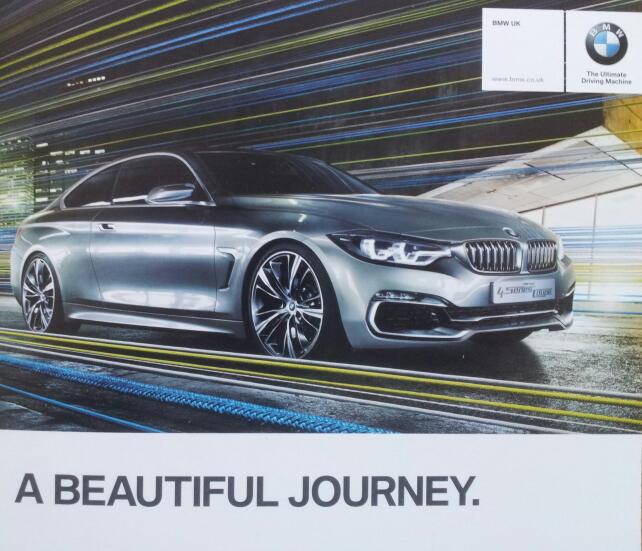
We just received our personal invitation to the BMW Ultimate Drive Event.

It's on this weekend, 19th-21st April, at you nearest partecipating BMW dealer. We are looking forward to see the latest models such as the facelifted Z4 convertible.

It's worth a mention that the invitation came with a rather nice brochure. MG

Thursday, 4 April 2013

BMW 3 Series GT. Contrasting opinions.

I've always been a big fan of BMWs even on Chris Bangle's  worst day! I do however find hard to appreciate the need or the function of the new 3 Series Gran Turismo.

I do understand the practical side of the hatch yet I prefer the Touring's style or the X3 if an higher driving position is your requirement. The 3 Series GT is priced so near an equivalent 5 Series Touring to already create conflict within the BMW brand without stepping into another manufacturer's threshold.

I was reading Will Nightingale's article on the May issue of WhatCar? magazine and I must admit that he's a very democratic and detailed journalist who managed to highlight the functionality of the interior without being too harsh on the exterior design. However I couldn't have contained myself from criticizing the odd looks.

The front end's double kidney which is the BMW signature is too big and the headlights are not as captivating as in the standard 3 Series. The back is rather heavy and the profile, for some reason, reminds me of a 1970's Lancia Beta Saloon which is not a good thing.

BMW should have learnt from the 5 Series GT. I can count in my hands how many I ever seen on the road. Even Citroën realised that the C6 was a step too far and never went back on that route. MG